
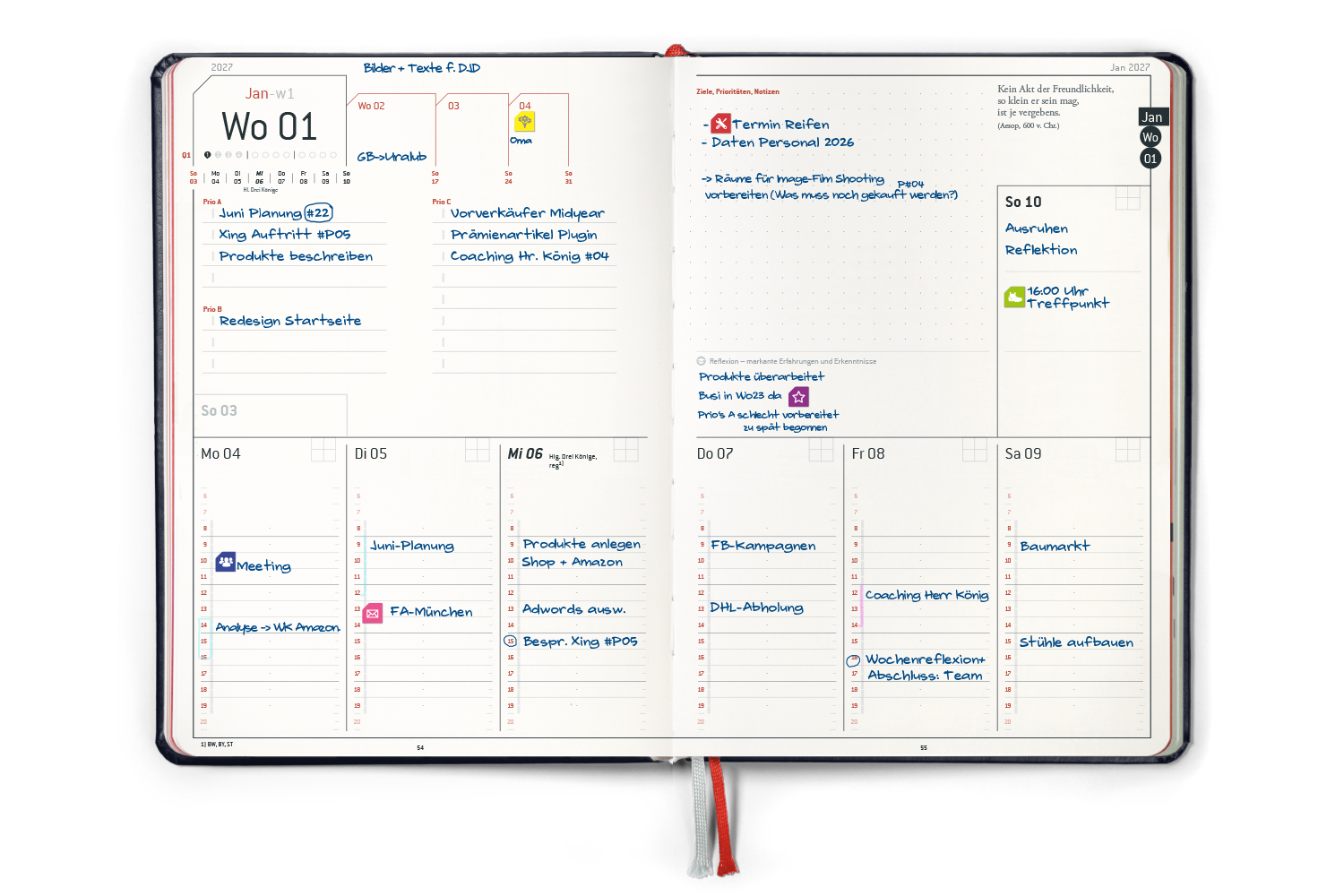
Week over, next week starts. → First review, then rest, then plan.
What is weekly reflection?
Weekly reflection is the deliberate close of your week: a short look back at what you had planned and at what actually happened. It is not a diary and not a reckoning with yourself, but an honest stocktake in a few lines.
The difference to simply ticking things off: ticking off only shows whether something is done. Reflecting shows why it worked – or didn't. That is where a better next week comes from.
Why reflection is a must
Without a review you repeat the same patterns. With a weekly summary, slow developments become visible – as if in time-lapse. You see what works and correct course early instead of discovering at the end of the year that a project has been stuck for months.
The week is the ideal unit for this: a day is too short to see patterns, a year too long to steer in time. A week gives you 52 chances a year to get a little better.
Reflection is a must
"Closing the week without reflection is a mistake." Weekly, in writing, short – that is enough.
The weekview rhythm: review, rest, plan
At weekview, reflection has a fixed place in the week:
- Saturday: review. The week is still fresh in your mind, details are not yet forgotten.
- Saturday 6 pm to Sunday 6 pm: rest. 24 hours of real break – no planning, no to-dos.
- Sunday evening: plan. Rested and with Saturday's insights, you set your three weekly goals.
This keeps looking back and looking ahead cleanly apart. Doing both at once usually just means planning the old week all over again.
Weekly reflection in 5 minutes: 5 steps
Look at your weekly goals
What did you plan on Sunday? Put your goals next to what actually happened.
What went well?
Three things that worked. Small progress counts too – it shows what to keep.
What didn't go well?
Three things – without self-criticism, just honestly. Planned too big? Interrupted? Wrong priorities?
What do I take with me?
One insight, in one sentence. No more. This one lesson is the real yield of the week.
What do I decide for next week?
One concrete decision: continue, change or let go. It goes straight into Sunday evening's planning.
continuechangelet go
Questions for your weekly review
The three basic questions work for every week. If you want to go deeper, these help:
- Focus: What did I spend most of my time on – and was that the most important thing?
- Priorities: Did I get to my B topics, the important things that are not yet urgent?
- Energy: What gave me energy, what drained it?
- People: Whom would I like to thank? Where do I need to clear something up?
- Balance: How were work, family, personal life and community distributed?
For more prompts, see the free worksheet "Fragenschatz Selbstreflexion" (PDF, German).
The most common mistakes
- Reflecting only in your head. Thoughts fade. Writing makes the difference – it forces clarity and makes progress visible.
- Too long, too detailed. If it takes an hour, you will stop after three weeks. Five minutes are enough.
- Reflection as a reckoning. It is about learning, not about blame.
- Reviewing and planning in one go. First review, then rest, then plan.
- Not recording insights. What you don't write down, you repeat. More in Securing insights.
Where weekly reflection lives in the weekview planner
| Planner | Space for reflection |
|---|---|
| Business Planner A5+ | reflection field on every weekly spread |
| LifeCoach A5 | own page each week: topics, highlights, lessons learned, summary |
| Essentials A4 | undated weekly reflection book, 156 weeks on one page each |
| weekPad Reflection A4 | tear-off pad: highlights, lessons learned, decisions, what counts next week |
With the weekview LifeCoach
A reflection page for every week: topics, highlights, lessons learned and summary.