
One year.
One strip.
Every calendar week of the year side by side – and below it one row per person. Who is on holiday when, when a shift stays open and when two projects collide is all there on a single sheet. No page-turning, no spreadsheet, no file that nobody opens.

The whole year on one surface.
Holidays, shifts and projects usually sit in three different systems. Here they sit side by side – ten rows one below the other, 2027 running from left to right. Who is away when, where something overlaps and which week is still free: you see it without turning a page.
10 planning rows
For staff, projects, machines or rooms – label them freely
Weeks to ISO 8601
Wk 01 to 53, plus the month-based naming such as „Mar-w1“
Colour-coded quarters
Each quarter in its own colour – you spot periods without reading
U and RV
Two columns for holiday entitlement and carry-over from the previous year
Eight places that make the difference.
The planner is not a grid of numbers – every zone has a job. Pick one and the image follows.


Ten planning rows
Numbered consecutively from 1 to 10. You label them with names, projects, machines or rooms – the grid dictates nothing.
Column U
The holiday entitlement for the current year, right next to the row it belongs to. No need to check a second list.
Column RV
The Carry-over holiday from the previous year. When you make an entry it is instantly clear how much is left.
Calendar weeks 01–53
Consistently to ISO 8601 – even the part-week at the turn of the year gets its own column.
Week naming by month
„Mar-w1“ instead of just „Wk 10“. In conversation with the team, that is the reference that lands.
Working days per month
Next to every month name is the number of working days it has – useful for capacity and billing.
Public holidays with legend
The public holidays are on the sheet. Regional ones are numbered and assigned to the German states below.
Two half-year bands
January to June on top, July to December beneath – both bands share the same layout, colour-coded by quarter.
Why a strip and not a table? Because a table has to be read first. A strip on the wall gets seen – by everyone walking past, without anyone opening a file.
Six views of the same year.
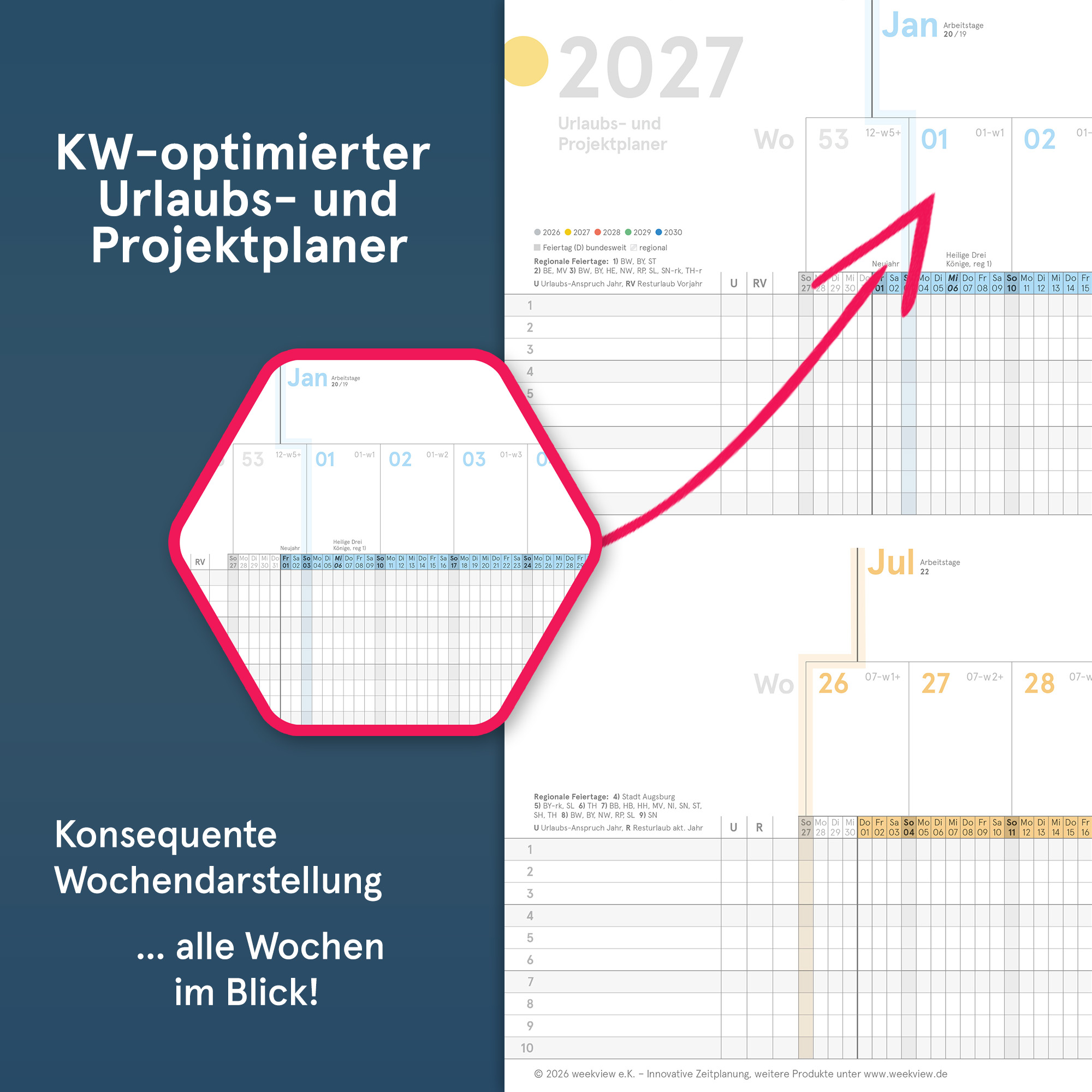
Every week in view
The week view runs straight through – even the week that falls between two months gets its own column.
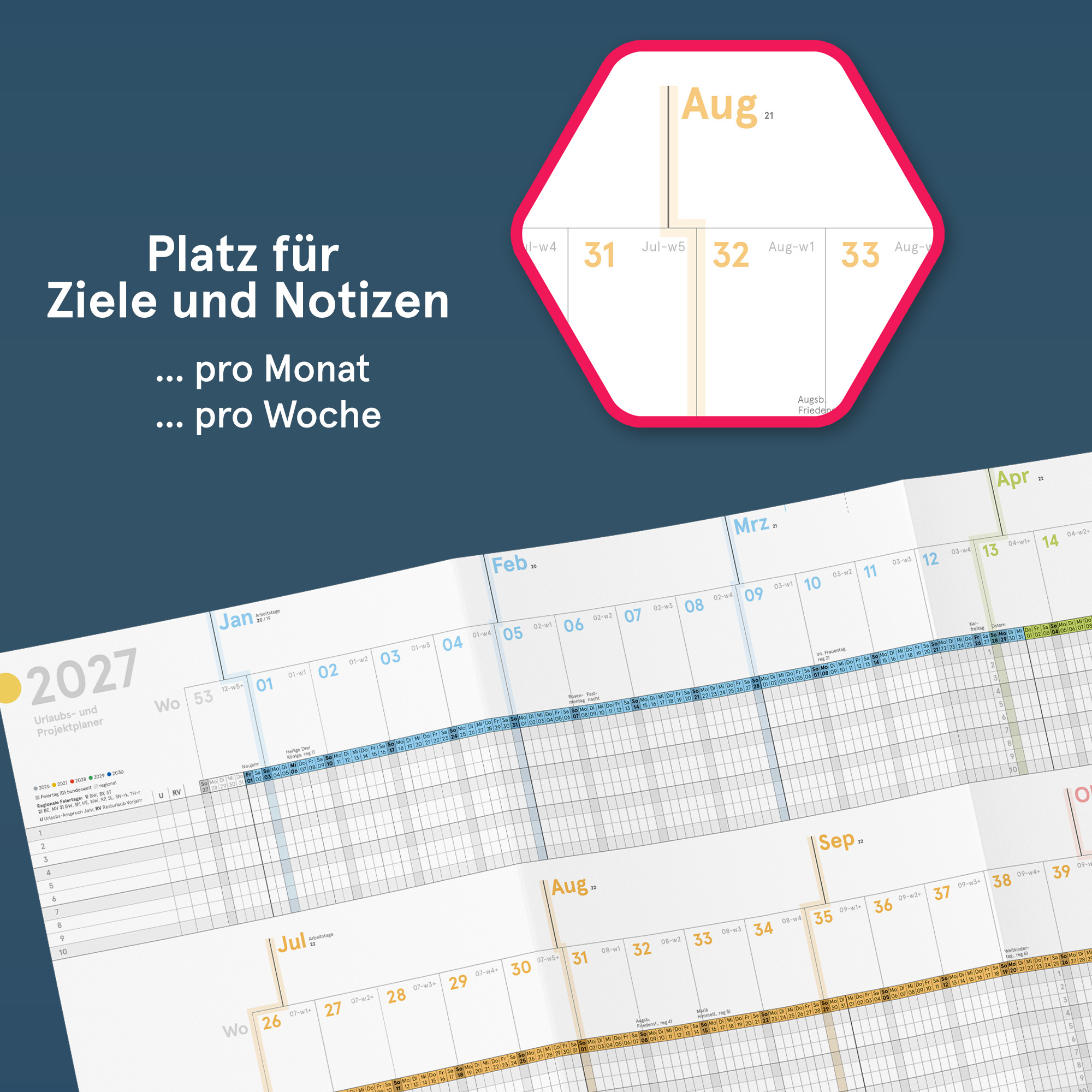
Room for goals and notes
Above the planning rows there is free space – per month and per week. You do not have to sacrifice a row for it.
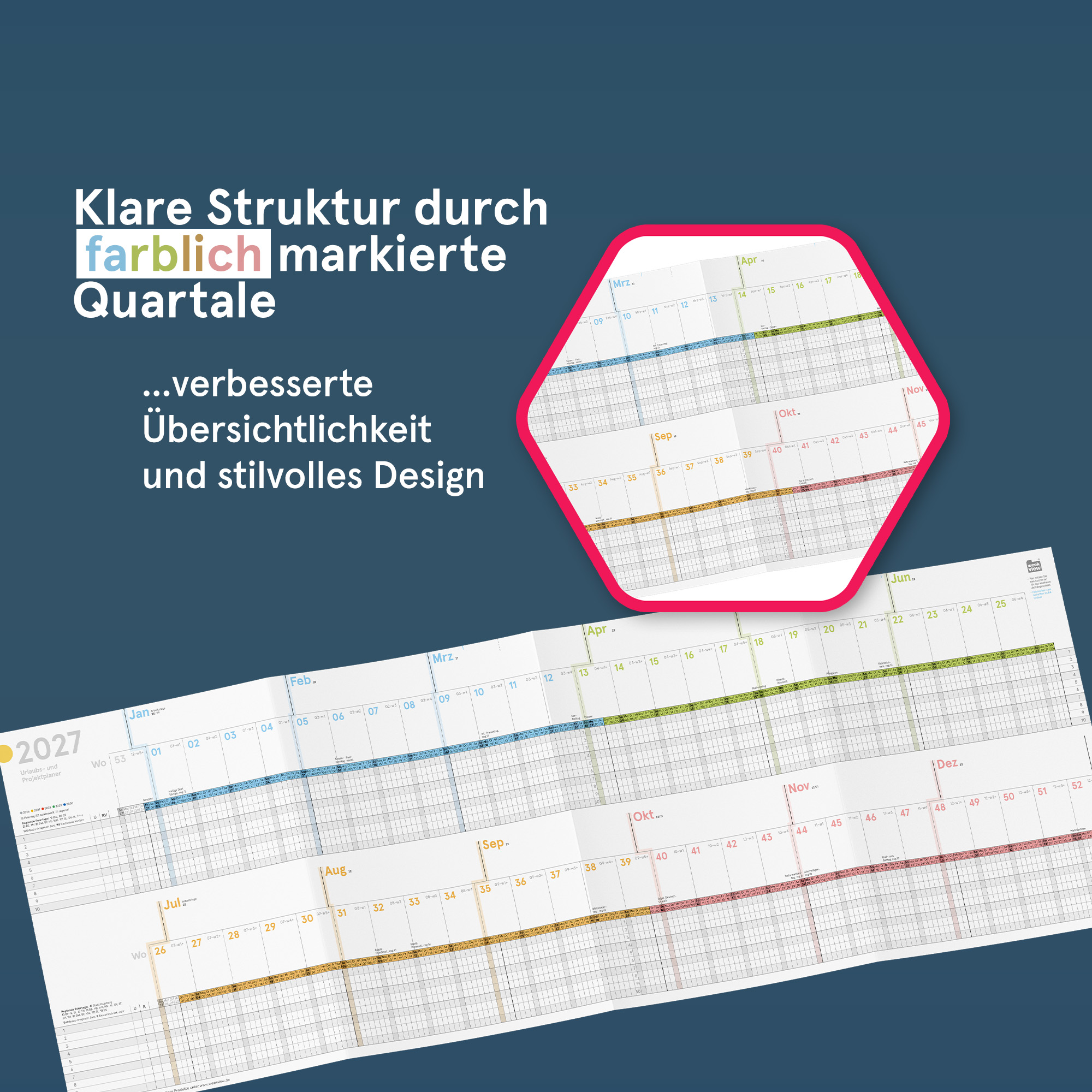
Quarters in colour
Q1 to Q4 are colour-coded. That way you spot periods from two metres away.
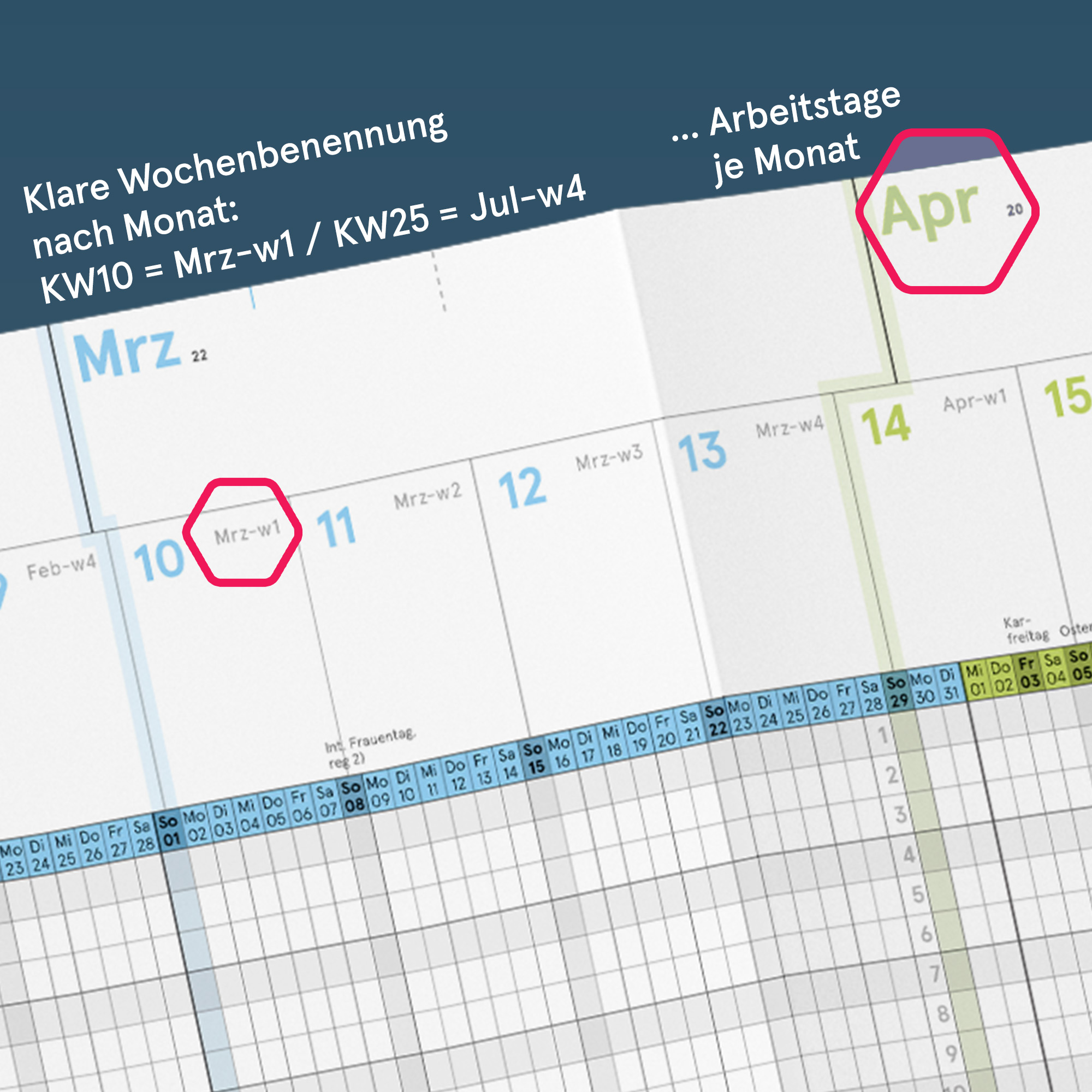
Wk 10 = Mar-w1
Every calendar week also carries its month-based name. Next to it is the number of working days.
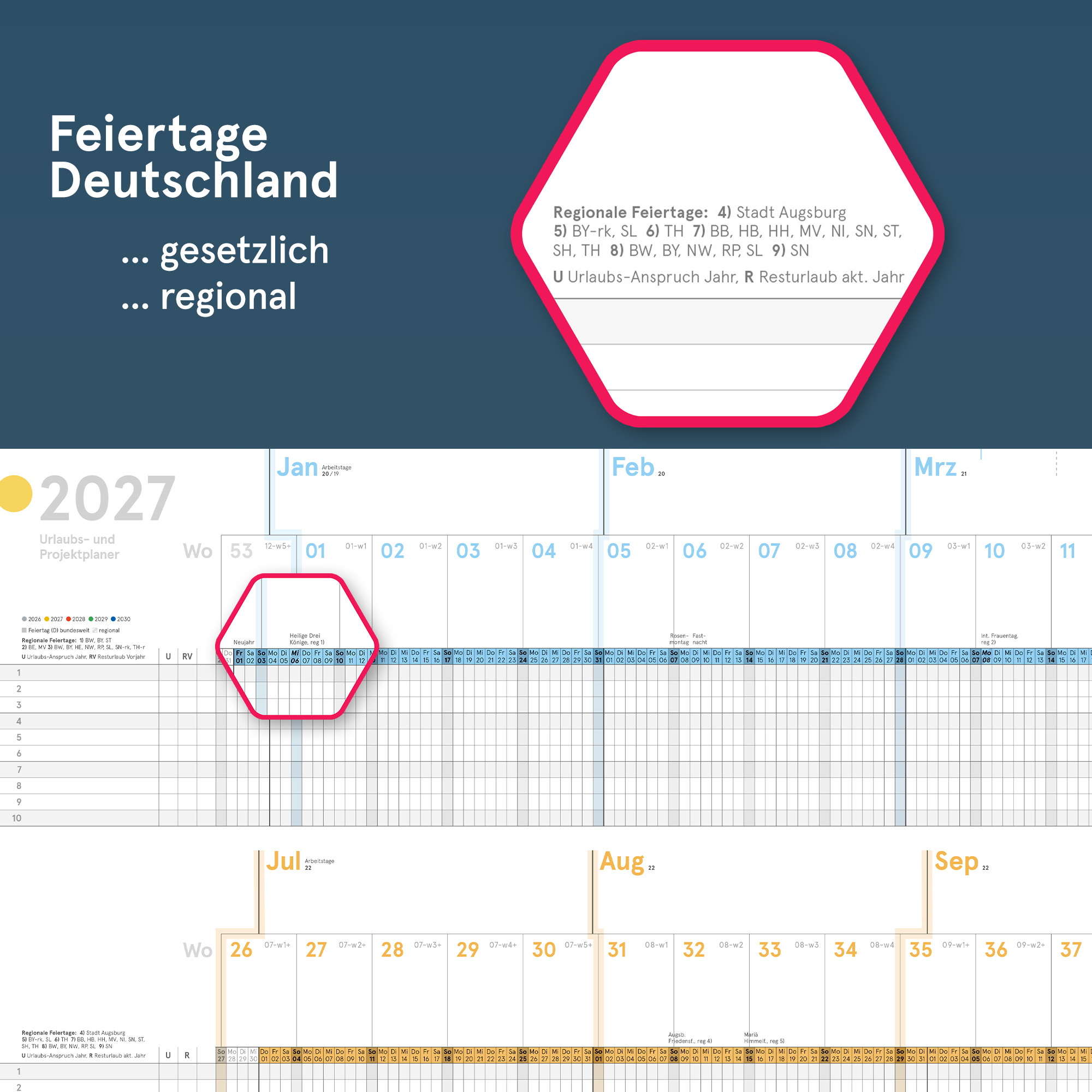
German public holidays
The public holidays are printed on; regional ones are assigned to the German states via a numbered legend.
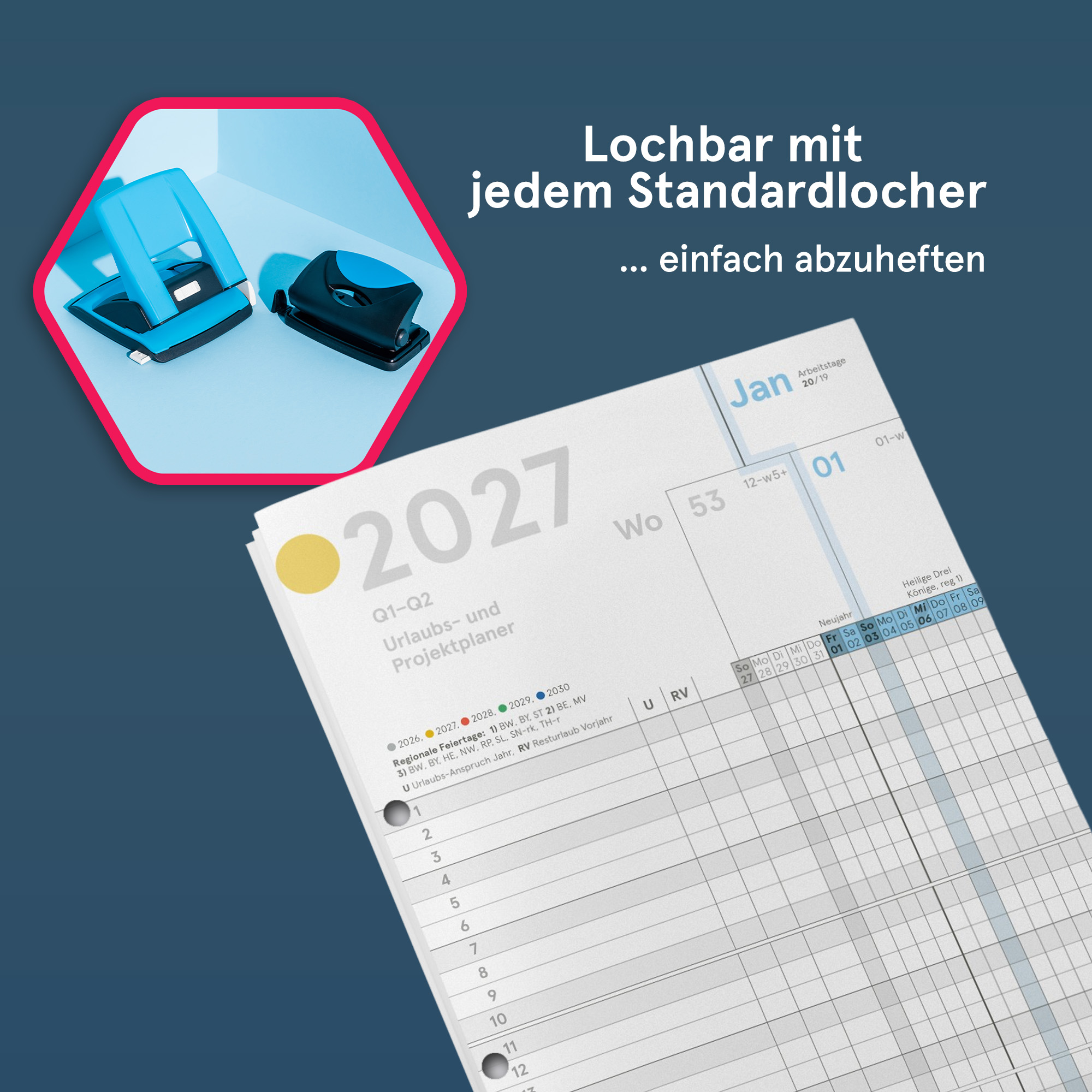
The concertina can be filed
The A5 version can be punched with any standard hole punch – and so moves straight into a folder or planner.
One planning grid, three ways to hang it.
The grid is the same in all three versions. What differs is how often you change it and where it hangs.
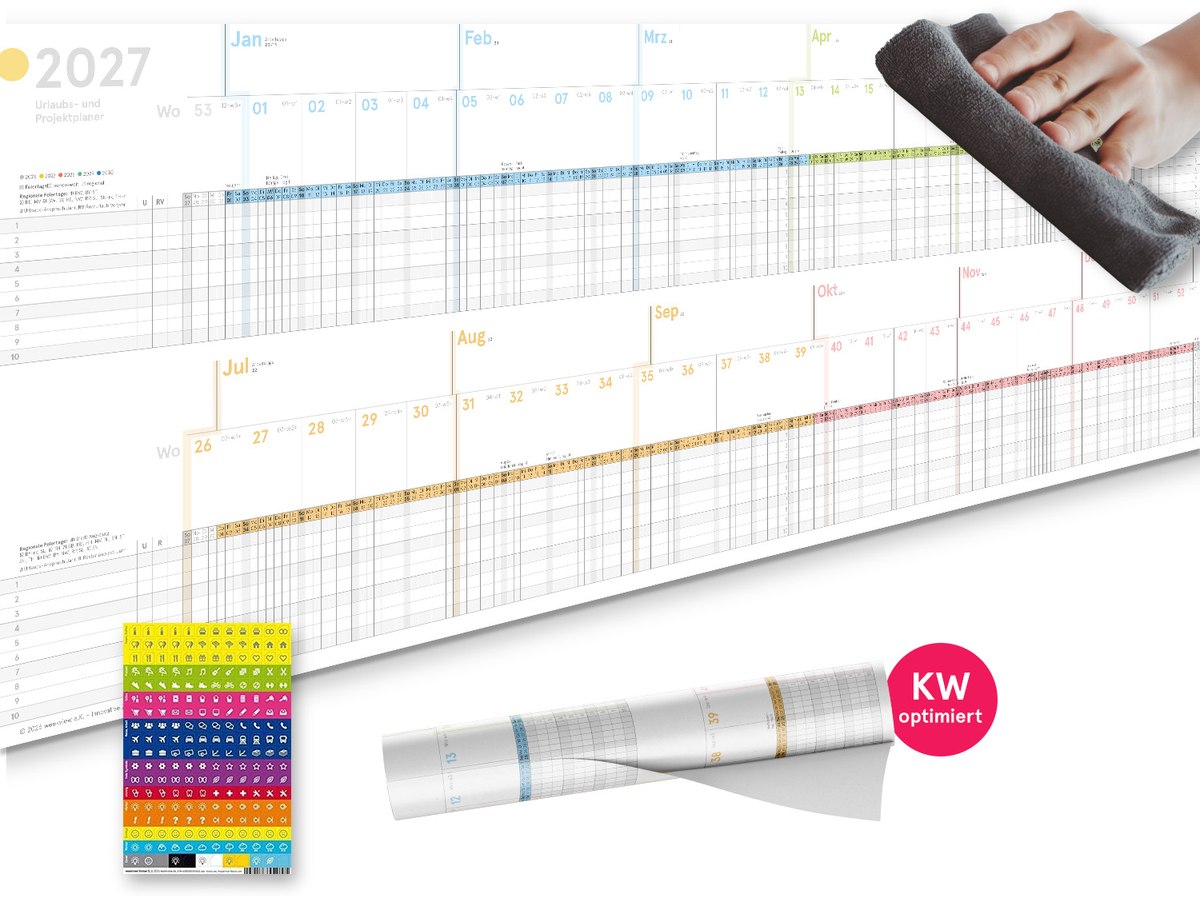
Holiday and project planner A4 2027 – wipeable
Laminated on both sides and writable with non-permanent markers. When shift plans change, you wipe and write again.
- Laminated & wipeable
- Delivered rolled, without creases
- approx. 82.5 × 29.5 cm
- 10 planning rows
- Base paper approx. 170 g/m²
- Colour-coded quarters
- Weeks to ISO 8601
- Made in Germany
Holiday and project planner A4 2027 – folded
The same surface of approx. 82.5 × 29.5 cm, folded down to A4 long. Written on with pen or pencil – for plans that stay put.
A5 concertina 2027
Unfolded approx. 84 × 20 cm, folded to A5. January to June on the front, July to December on the back – with up to 20 planning rows.
Prices incl. VAT · Current availability is shown on the respective product page.
Mark it first, discuss it after.
A year planner lives on entries that go in fast and are allowed to disappear again. Three approaches that have proved themselves.
Non-permanent marker on the laminated version
Non-permanent markers wipe off without residue. Shift plans that change every week stay permanently up to date.
View whiteboard pens →Coloured dots and labels
If you work with fixed categories – holiday, training, on-call – stickers get you there faster than handwriting.
View labels →Symbols instead of words
Icons for recurring dates keep the row readable without filling it. With ten rows side by side, that makes a real difference.
View headers & icons →Who plans with it.
The practice manager
Eight employees, changing consultation hours. She needs a surface everyone can look at – and that can be changed when someone swaps.
WipeableThe workshop foreman
He plans not just people but machines and bay slots too. Ten rows are enough for him – as long as they hang where everyone sees them.
10 planning rowsThe HR manager
She tracks holiday entitlement and carry-over anyway. The U and RV columns save her the side calculation when approving.
U and RVThe project manager
He works in weeks, not days. Month-based week naming and colour-coded quarters are exactly his language.
ISO 8601What else you should know.
How big is the planner?
Open, the A4 versions measure approx. 82.5 × 29.5 cm in landscape. Unfolded, the A5 concertina is approx. 84 × 20 cm in size and folds down to A5.
How many people can I plan for with it?
The A4 versions have 10 planning rows, the A5 concertina up to 20. A row does not have to be a person – it can just as easily stand for a project, a machine or a room.
What do U and RV mean?
U stands for the holiday entitlement for the current year, RV for the carry-over holiday from the previous year. Both columns are pre-printed and sit directly next to the planning row they belong to.
Are public holidays printed on?
Yes. The public holidays are on the sheet. Regional holidays are numbered and assigned to the German states in the legend, for example „reg 1) BW, BY, ST“.
How do the wipeable and the folded version differ?
The planning grid is identical. The wipeable version is laminated on both sides, is delivered rolled and is written on with non-permanent markers – entries can be wiped away again. The folded version is unlaminated paper, arrives folded to A4 long and is written on with pen or pencil.
Which pens are recommended for the wipeable version?
Non-permanent markers, for example the Staedtler Lumocolor non-permanent. They come off dry or with a damp cloth, leaving no residue.
Does the A5 concertina fit in a ring binder?
Yes. It can be punched with any standard hole punch and filed – or slipped into an A5+ or A4 planner.
The holiday requests will come anyway.
Better that they land on a surface that already shows who else is away. One sheet, ten rows, the whole of 2027.
View the wipeable version · 19.90 €Also a good match
Wall planner A1
The large format for the wall – with school holidays printed on. For when the year needs space.
View →Wall planner A2
The smaller wall version – for offices where A1 takes up too much wall.
View →Year planner A4
The year in landscape for your desk – compact and with no wall fixing.
View →Wall planner accessories
Labels, headers & icons and everything for hanging it up – turning the sheet into a tool.
View all →
weekview holiday and project planner 2027, approx. 82.5 × 29.5 cm: 10 planning rows, calendar weeks to ISO 8601, public and school holidays included.

weekview A5 concertina 2027: printed both sides, 6 months per side, up to 20 planning rows, unfolds to approx. 84 × 20 cm. Compact for planners and on the go.

weekview holiday & project planner 2026 A4, laminated and wipe-clean. Flexible year planning for teams & projects. Made in Germany.

weekview A5 leporello 2026: double-sided annual overview for holidays, projects and shifts. Compactly folded, A5. Made in Germany.

weekview holiday & project planner 2026 A4, colour and folded. Space-saving annual planning for holidays & projects. Made in Germany.