

Six days of work.
One day of rest.
The 7-day week is not something calendar makers invented — it is a rhythm that has proved itself over thousands of years. weekview makes it the central unit of your planning: big enough for the overview, small enough to actually get done.
The 7-day week is the rhythm of six working days and one day of rest. weekview makes it the central planning unit: on Sunday evening you plan three weekly goals and sort tasks by A/B/C, from Monday to Friday you get things done, on Saturday you review the week in five minutes, and from Saturday 6 pm to Sunday 6 pm you rest. That gives you 52 chances a year to get better.
Why the week wins.
Ask yourself: what has to be finished by Friday? The answer comes easily. Ask the same question about the month? Suddenly everything is vague.
Too small for goals
The minute-by-minute daily plan is a relic of the time-clock era. After the first interruption it is waste paper. At weekview the day is only the fine-tuning inside the week.
The sweet spot
Always 7 days, always the same rhythm, Monday to Sunday. The whole week sits in front of you on one double page — plannable, reviewable, robust against interruptions.
Out of step with the rhythm
28 to 31 days, and it starts somewhere in the middle of a week. The month is a calendar unit, not a unit of experience — weeks run straight across its borders.
„A method is a tool. The week is the workbench."
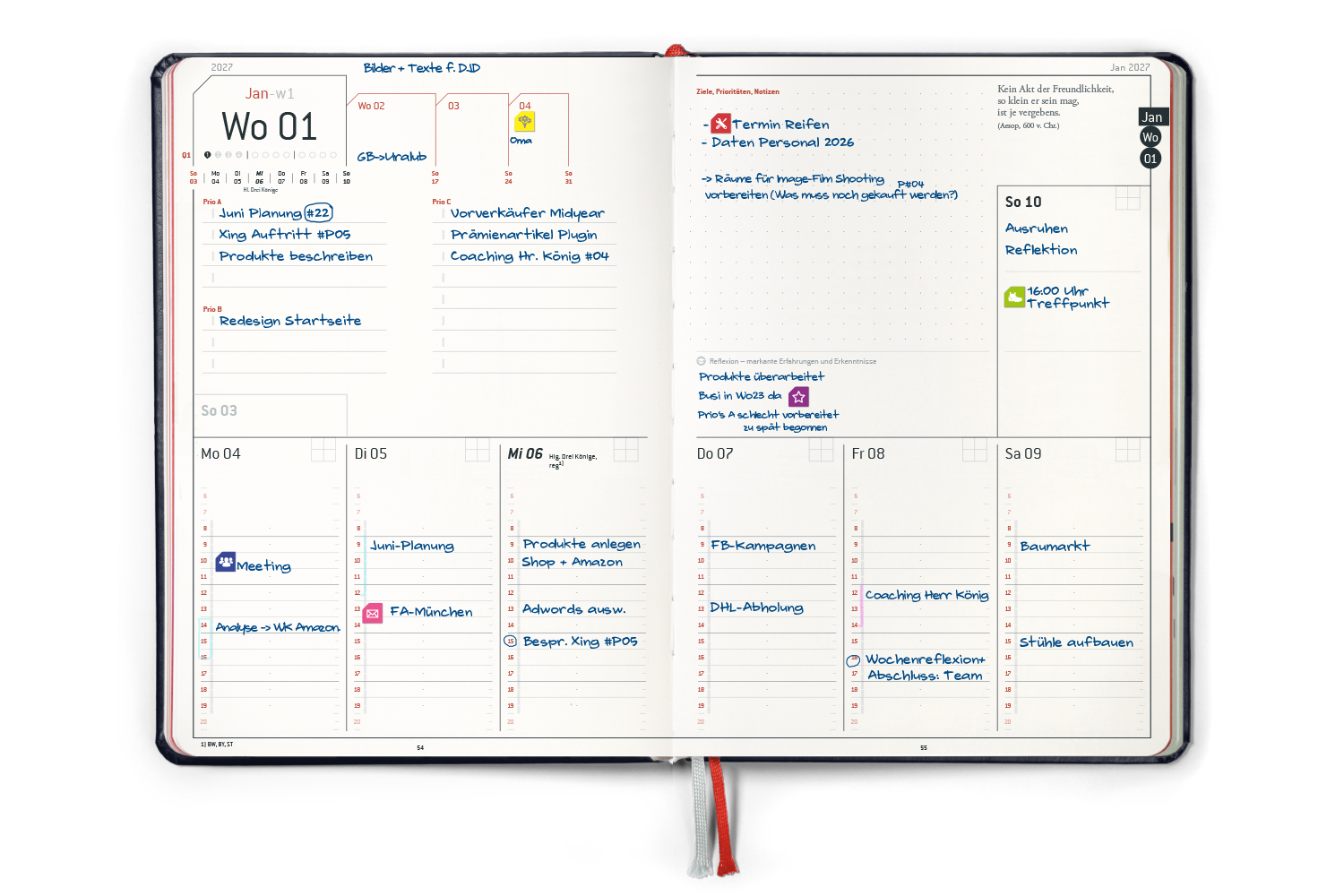
Your whole week.
One spread.
The real game changer is the integration: planning, priorities, appointments, notes and reflection all sit on one surface — instead of scattered across a calendar, a to-do app and a notebook.
- 1Weekly goalsTwo or three outcomes you measure the week by once it is over.
- 2A/B/C prioritiesTasks sorted by importance — A must, B should, C can.
- 3Appointments & daysAnything binding goes into the day. The shaping happens at week level.
- 4Weekly reviewThe built-in reflection field — for an honest close to the week on Saturday.
How a weekview week runs.
Plan
20–30 minutes with a clear head: recognise your weekly goals, set A/B/C, think through the order, agree it with others.
Do
Big rocks first, routines carry the rest. Flexible within the day, stable across the week.
Reflect
Three questions, five minutes, in writing: what went well? What did not? What do I take with me?
Rest & celebrate
24 hours of real rest — planned in, with no guilty conscience. That is why it holds.
chances a year to get better.
Plan in weeks and you plan and review 52 times a year — instead of 12 times (the month) or once (the New Year resolution). That is not a detail. That is the difference between reacting and shaping.
A rhythm older than any calendar.
Six days and a day of rest
Day, month and year follow the earth, moon and sun. The seven days of the week have no such clear model in the sky. Their rhythm goes back to the biblical creation story and the Sabbath – six days of work, one day of rest.
From Sabbath to Sunday
In the year 321, the Roman emperor Constantine declared Sunday a day of rest. Since then, the 7-day week has shaped work, school and leisure in large parts of the world.
Monday is day 1
Under ISO 8601 the week starts on Monday. Calendar week 1 is the week containing the year's first Thursday, so a year has 52 or 53 calendar weeks. All weekview planners count this way.
The week as a workbench
weekview uses this rhythm on purpose: the whole week sits on one double page, with weekly goals, priorities, appointments and reflection. More in Weekly planning instead of daily planning.
The 7-day week, briefly answered.
What does "7-day week" mean at weekview?
Why does weekview plan in weeks rather than days?
When does the week start – Monday or Sunday?
How many weeks does a year have?
Why a fixed day of rest?
How long do planning and reflection take?
The week is only the beginning.
Your week is already waiting.
Every weekview planner puts the week at the centre — with weekly goals, A/B/C priorities and a built-in weekly review.
Find your weekly planner