
Noticed, forgotten, repeated. → Noted, bundled, applied.
What are insights?
An insight is a lesson that changes how you act in future. Not "the week was stressful", but "If I don't plan a B task on Monday, I won't get to it all week". A good insight is concrete, fits into one sentence and can be turned into a decision.
In business this is often called lessons learned. It means the same: learning from experience instead of just having it.
Why insights get lost
Without recording them, what you learn evaporates. You notice something in week 7 – and make the same mistake in week 20. That is not a lack of discipline; everyday life simply buries insights under new impressions.
Three reasons are typical:
- No fixed place. Notes on scraps of paper, on the phone, in your head – none of it is at hand when you plan.
- No fixed time. Reflecting "whenever there's a chance" means reflecting rarely.
- No look back. Insights are noted down but never looked at again when planning.
Reflection as a learning booster
Weekly and quarterly summaries make slow developments visible – as if in time-lapse. Securing insights turns experience into a lasting advantage.
The cascade: week → quarter → year
Insights build up in stages – just like goals, only in the opposite direction:
- Week: In your weekly reflection on Saturday you note one insight. No more.
- Quarter: After 13 weeks you have up to 13 insights. In the quarterly review you bundle them into the three most important lessons.
- Year: In the annual review, four quarters become the guidelines for the next year.
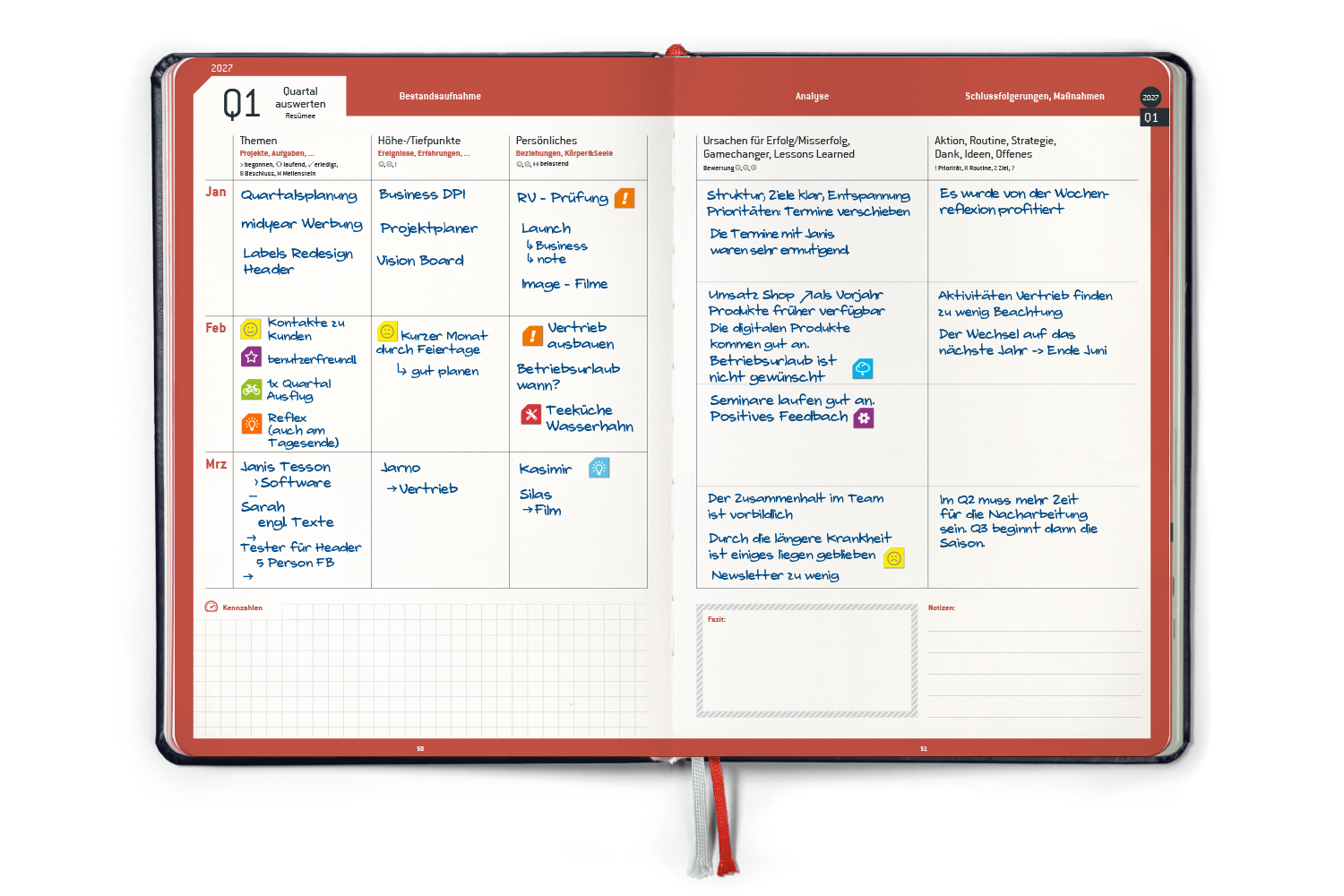
The quarterly curriculum in the weekview Business Planner follows this idea: collect, plan, implement, observe, evaluate. Evaluation is not an add-on but the step that makes the next quarter better.
Securing insights in 5 steps
Note one insight every week
On Saturday in your weekly reflection: what do I take from this week? One sentence is enough.
Always in the same place
In the planner itself – on the reflection, quarter or lessons-learned page. That way everything is at hand when you next plan.
Bundle them at the end of the quarter
Read through all weekly insights. What keeps coming up? That gives you the three key lessons of the quarter.
Turn them into actions
Every lesson gets a concrete consequence: a routine, a rule, a task with priority B.
Apply them at the start of the quarter
Before you set your new quarterly goals, read your secured insights. Only then plan.
Insights as a common thread
Across quarters, a common thread of your development emerges. You see not only what you have achieved but how you plan, prioritise and lead better. That is self-leadership in a weekly rhythm.
| Only reflecting | Securing insights | |
|---|---|---|
| Result | good feeling | concrete lesson |
| Place | in your head | fixed place in the planner |
| Bundling | ✗ | ✓ three per quarter |
| Effect | fades | flows into the next plan |
The most common mistakes
- Too general. "Plan better" is not an insight. "A B task first thing on Monday" is.
- Too many. Nobody reads a long list. Better three that you actually apply.
- Only noting mistakes. What went well is an insight too – it shows what to keep.
- Never looking again. An insight is only secured once it is on the table when you plan.
Where to secure insights in the weekview planner
- Business Planner Pro A4 and Business inserts A5: own "Lessons Learned" page, plus the annual review.
- Business Planner A5+: reflection field each week, quarterly curriculum and project reflection on the project pages.
- LifeCoach A5: weekly reflection with lessons learned on a page of its own each week.
- Essentials A4: fields for insights and things worth remembering every week, review per quarter and year.
- X17 Tools: lessons-learned page for the X17 system.
With the weekview LifeCoach
Reflection and insight pages for lasting growth.